
Smart Irrigation Systems in the UAE: A Practical Planning Guide
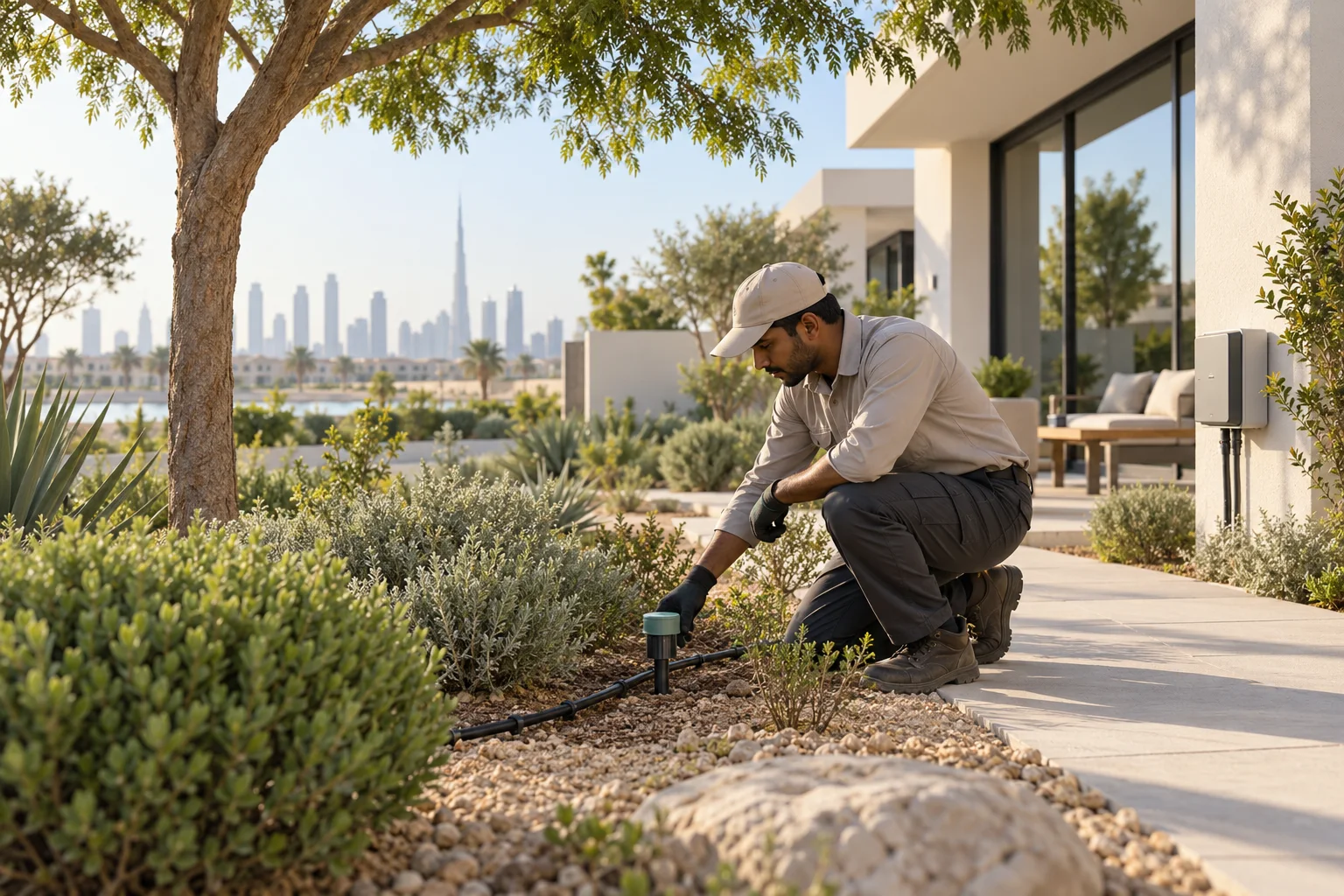
In the UAE, a well-designed garden has to balance shade, plant health, heat, soil conditions and a dependable water plan. Smart irrigation can help make that system easier to manage—but a controller alone cannot compensate for unsuitable planting, leaking pipework or poorly arranged zones. Start with the landscape, then select the technology.
What does smart irrigation include?
“Smart irrigation” describes irrigation that can be adjusted using a controller, schedule, sensor or remote monitoring. A system may combine several elements: separate watering zones, drip lines for planting beds, soil-moisture or weather inputs, automatic valves and alerts for unusual flow. The right combination depends on the site; not every garden needs every device.
The purpose is practical control: deliver water to the intended planting area, at a suitable time, and make it easier to spot faults. Dubai Electricity and Water Authority (DEWA) advises watering landscapes before 8 am or after 6 pm, adjusting schedules to seasonal conditions, checking valves and sprinkler heads for leaks, and directing spray away from paved surfaces. See DEWA’s irrigation conservation guidance.
Plan the landscape before choosing the controller
Map sun, shade, soil and slope
Walk the site and note full-sun areas, shaded corners, exposed edges, slopes, paved surfaces and planting beds. Soil that drains quickly may need different run times from compacted or slower-draining areas. A site plan should also show valve locations, water access, existing trees and places where runoff could reach a path or building.
Group plants with similar needs
Divide the garden into zones that have similar exposure and water requirements. Trees, shrubs, groundcovers and lawn should not automatically share one schedule. Grouping them sensibly helps avoid overwatering one area just to meet the needs of another. For a new or redesigned garden, Sabah’s landscape design and irrigation service can be considered alongside the planting plan.
Choose a water source and irrigation method carefully
Confirm the available water source, connection arrangements and any project or authority requirements before specifying equipment. For development projects, DEWA’s water planning guidelines say potable water is not normally supplied for irrigation or landscaping, subject to stated exceptions and conditions. That guidance is project-specific: confirm what applies to your site with the relevant authority and project team rather than assuming the same rule for every private garden.
Drip irrigation is often worth considering for trees and planted beds because emitters can deliver water close to roots. Sprinklers may suit some open areas, but their coverage should be checked so water is not routinely landing on walls or paving. DEWA’s guidance also recommends checking for leaks and avoiding fine spray that is easily carried away. Select emitters and pressure controls to suit the actual layout, not just the controller’s feature list.
Dubai Municipality has reported using recycled water for irrigation in its municipal greening programme. This demonstrates a local public-landscaping approach; it does not establish that recycled water is available or required for a particular private site. See the Municipality’s 2024 tree-planting and sustainability update.
Set up zones, schedules and sensors
Once planting and water supply are understood, a contractor can size zones and set an initial schedule. Use a controller that the owner or facilities team can actually operate. Where suitable, soil-moisture or weather inputs can help inform adjustments; they still need correct placement, commissioning and occasional checks. A schedule should be reviewed when seasons change, plants establish, or site conditions are altered—not left untouched indefinitely.
At commissioning, run each zone and look for blocked emitters, overspray, runoff, weak coverage and leaks. Label valves and zones, show the owner how to use the controller’s manual override, and record the initial settings. If a sensor or flow alert is installed, test that it reports a useful condition rather than simply adding another device to maintain.
Keep the system efficient after installation
- Inspect filters, valves, emitters and sprinkler heads; clear blockages and repair leaks promptly.
- Check that spray reaches planting rather than roads, walls or paving.
- Review schedules after planting changes, seasonal shifts or visible signs of stress or runoff.
- Keep controller access and zone labels available to the person responsible for maintenance.
- Ask for a handover that explains the water source, isolation points, routine checks and any authority conditions.
For broader landscape work, see Sabah’s landscaping services in Abu Dhabi. The most useful “smart” feature is a system that fits the planting and site, can be maintained locally, and makes problems visible early. To discuss a project, contact Sabah Al Mustaqbal.
Frequently asked questions
What is the best irrigation time for a UAE garden?
DEWA advises watering before 8 am or after 6 pm and adjusting schedules to seasonal conditions. The right run time and frequency still depend on the plants, soil, exposure and irrigation layout, so inspect the site and adjust rather than relying on one fixed timer setting.
Does every smart irrigation system need soil sensors?
No. Sensors can be useful where they are appropriate and correctly installed, but a well-zoned controller, suitable emitters, leak checks and a schedule that is reviewed can also be important. Choose equipment based on the garden and maintenance plan, not on the number of connected features.
Can recycled water be used for a private landscape?
It depends on local availability, the project and applicable authority requirements. Dubai Municipality’s municipal greening programme uses recycled water, but that does not mean it is available or required at every private property. Confirm the supply and conditions with the relevant authority and project team.
Need expert project support?
Talk to Sabah Al Mustaqbal about construction, landscaping, surveying, equipment, materials, greenhouses, or HVAC and MEP requirements in the UAE.
